"In the Canadian winter working at the heart of the Chinook"
Brad Legare is a Canadian Aircraft Maintenance Engineer working for Helifor Industries: he told Helipress how did his love for the BV234 and photography started
by Nicola Zamperini
Can a man be considered "veteran" at just 35? For world famous athletes, the answer is often simple. For those who work in a world such as aviation (especially in the helicopters industry), is a little more difficult.
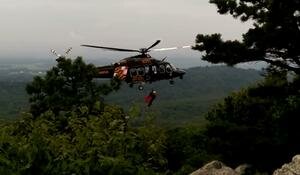
Brad Legare is an Aircraft maintenance engineer working for the Canadian Helifor Industries: has 15 years of experience and a lot of technical knowledge, but above all, Brad is also is a great rotographer, a photographer specialized in helicopters. In mid-June, with the shot you see on the cover, posted on his Instagram account (bradickulous) Brad won the photo of the week award of Vertical Magazine.
At the center of the shot is his favorite subject, as he explained in our interview.
Further down in the page, we have collected for you in a photogallery his best shots.
Brad, let's start from you. Who are you and what do you do for a living?
I am 35 years old and currently live in Victoria British Columbia, located at the southern tip of Vancouver Island on the west coast of Canada. I have been an Aircraft Maintenance Engineer for about 15 years with all but one of those years working in the heavy lift sector of the helicopter industry with Helifor Industries. I took a one-year break from Canada and spent it working in the jungles of Papua New Guinea in the South Pacific with Columbia Helicopters. I also have a very strong and understanding wife for putting up with me working away from home for extended periods of time.
When did you start your taking pictures of helos?
A few years into my career I realized that I live and work in some of the most remote and beautiful locations on earth and wanted to take advantage of the opportunity I had in front of me. Digital cameras were starting to become more affordable at that time so I bought my first one, a Canon PowerShot. From that point on I was always looking at new equipment and techniques to improve my experience with photography. It wasn’t long after that I switched to a DSLR and haven’t looked back.
What is your favorite helicopter?
Hands down my favorite helicopter is the Boeing Vertol 234, also known as the Chinook. The largest civilian registered helicopter in North America. A very technically advanced aircraft for its time considering it is over 35 year old technology. The raw power and lifting capacity always gave me a great respect for it. It demanded everyone involved to be at the top of their game whether it be the maintenance crew or the pilots.
On your instagram profile we can see a BV107: can you tell us something about this beauty?
I work on this helicopter majority of the time. Most of these are from the 1960’s so some of them are high time machines but very well maintained, we had one that had over 70,000 flight hours. We use them for various types of external lift projects. The BV107 is extremely reliable and is capable of flying over 2500 hours per year doing mostly heli-logging, quite remarkable considering the work and environment we use them in. They are powered by two General Electric CT58-140 engines and have an external lifting capacity of 10,000lbs.
Is there any specific issue regarding weather in Canada for maintenance operations?
The weather in Canada goes from both extremes of hot and cold every year. Due to the remote nature of all of our operations, we do not have the luxury of working in a climate-controlled hangar. Almost all of our maintenance is done underneath the stars unless it’s something major.
And what about maintenance work in winter time?
The west coast of British Columbia is known for its rain and snow in the winter months, so we must pack around all the appropriate covers for the aircraft to prevent it from icing up overnight. Occasionally the temperature will drop below -20C, when this happens we have to change the oils in the rotor heads as it is not suited for the extreme cold. We also carry around large heaters for defrosting and melting snow build up that accumulates overnight. Other then that it is not much different as long as you dress appropriately for the weather.
On what helicopters do you perform maintenance?
Throughout my career I have been fairly limited in the types of helicopters that I work on. The three different ones being, the Hughes 369D (500D), Boeing Vertol 107, and Boeing Vertol 234 (Chinook).
What kinds of operations do like the most?
Considering that our company only does external sling load, I find the specialized heavylift work more rewarding. We have had a few projects where we will provide support to power line construction by setting towers and moving equipment for them from site to site. This is unique work and requires precision flying from our pilots.
Once the temperatures heat up in the summer we will occasionally be called to help with forest fire fighting throughout western Canada. This is usually the most exciting as we meet a lot of other helicopter companies called for the same reason and end up seeing old colleagues and friends all working together. Currently we are seeing one of the worst forest fire years on record and it’s still early in the season.
What kind of equipment do you use to take your pictures?
I am currently using a Nikon D7000 for most of my shots with 3 different lenses, Nikkor 18-105mm, Nikkor 55-200mm and a Nikkor 50mm. Some of the pictures you see on social media will be done simply enough with an IPhone and the occasional GoPro shot as well.
Do you think that the social media are spreading the importance of aerial work?
I very much do. In the last few years Instagram has exploded with many profiles featuring fantastic heli photos from all over the world. It’s very interesting to see the different types and styles of external lift work and the creativity that goes into capturing many of those photos. Facebook also has many photo contests that feature some spectacular shots.